Castle of
mushroom bottoms

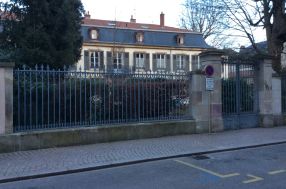
At the beginning of the 18th century, Christophe LE PRUD'HOMME, Count of Fontenoy, had a large castle built on the edge of the Chemin de la Papeterie, surrounded by a park and French-style gardens. The building contains at its heart a remarkable double-flight curved staircase under a high oval ceiling painted in trompe-l'oeil, a centerpiece still visible today. This baroque work, very similar to that of the Ferraris hotel in Nancy, is attributed to Giacomo BARILLI, collaborator of the famous Italian decorator Francesco BIBIENA, who came to Lorraine at the request of Duke Leopold I, in order to build his opera house there. Stones from the remains of the old hamlet of Saint-Barthélemy were used for the construction. Although we do not have any interesting details about the construction of the castle itself, there are nevertheless some notes on its appearance: "The castle of Monsieur de Fontenoy is very well built, the gardens are magnificent and there are very beautiful fountains." The site then became a regular meeting place for Duke Leopold I of Lorraine, who went there with his court to taste Champigneulles wine in particular. A Champagne grape variety was in fact ordered by the count, the vine would survive for a long time under the name Plante de Reims. Around its castle, which brings a significant boost to activity for the locality, the area is teeming with activities. Paper, tiles, bricks and earthenware are produced in Champigneulles. This is where the history of the famous Lunéville earthenware factory begins. As early as 1711, Jacques Chambrette, a master potter from Dijon, created his first pieces there for the Count of Fontenoy, before his son established the well-known factory in Lunéville eleven years later. In 1758, the imposing building and its gardens are said to have seduced Voltaire, who was seeking to return to Lorraine and more particularly to the court of Lunéville, around Duke Stanislas. But the latter did not give it a favorable response, on the orders of his son-in-law King Louis XV who did not want to see the Enlightenment writer move closer to Paris, following the dispute linked to the "Geneva" article in the Encyclopedia. The castle then had different owners during the 18th and 19th centuries. It was in 1888 that the industrialist Victor HINZELIN, who ten years later would become the co-founder of the Brasserie de Champigneulles, producing "the great blonde of Champigneulles, Queen of beers", became the owner of the site. During the Second World War, the castle was occupied by Nazi Germany before being sold at the Liberation by the HINZELIN family. It became the property of the City in 1951 and housed a school there until 2017, as well as school catering, the municipal music school and various association premises. Over the years, the castle grounds have also undergone many transformations, changing from a French-style layout to an English-style garden. To prevent it from becoming a housing estate, the City initiated protection procedures in 1955. The park is now classified as a monument and site. Composed of a central building, housing the monumental staircase, and two large wings, the castle totals approximately 3000 m2 on three levels and has a central courtyard of honor and direct access to its park. The complete redevelopment of the Château de Bas constitutes the heart of the new heritage plan for the town of Champigneulles. The operation consists of optimizing the use of available surfaces, rehabilitating interior spaces, preserving and enhancing remarkable heritage elements and reclaiming exterior spaces. Three main directions were identified following a preliminary study and consultation with residents so that the population could re-appropriate the site through the need to develop public services there, while creating an exceptional reception area. A layout is planned for each wing, depending on the vocations: an early childhood wing, a cultural and community life wing and the central building with an events, economic and tourist center. Today, as part of the heritage plan for the 2020-2026 term, intended to allow for a reorganization and more efficient management of municipal buildings, the castle has once again become a school for a period of 2 years, in order to expand the Jean Moulin school and integrate the activities related to this school present in the castle, namely school catering, the RASED, and extracurricular activities.