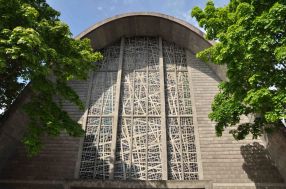
Saint-Maur church
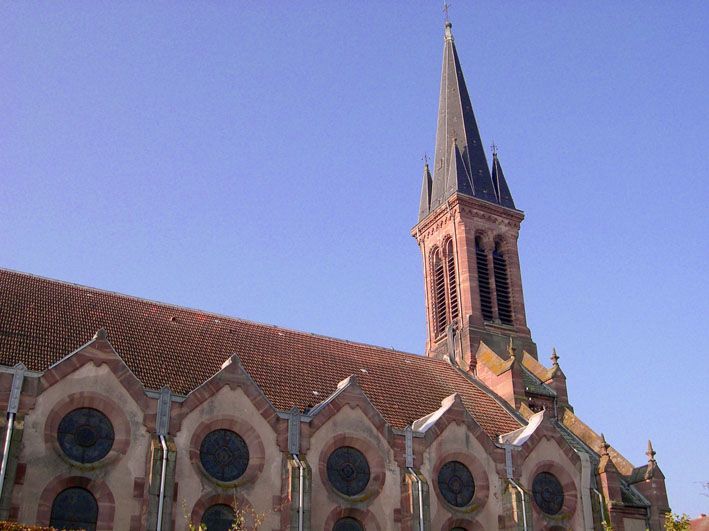
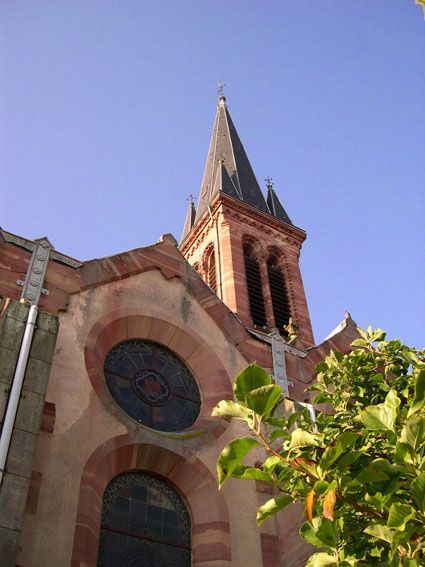
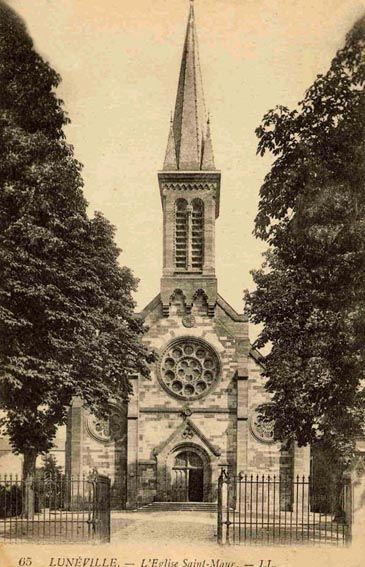
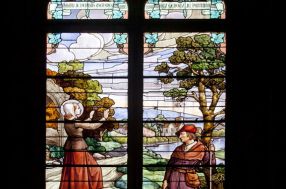
Built in 1854 by the builder Abbot Joseph Trouillet, who also built the Saint-Epvre basilica in Nancy, it bears the name of the saint celebrated in the same place during the Revolution in a chapel of the eponymous hospital. This building is in the Romano-Byzantine style, mixed with Romanesque and Gothic. The statuary and stained glass windows of the choir and nave are significant of the motivations of the builder priest. Located on a major artery of the city, it is nevertheless a little set back and separated from the street by a very pleasant little tree-lined square. The Saint-Maur church is also closely linked to that of the Viller district as well as to the Keller and Guérin earthenware factory. Open to the public: only during hours of religious worship. (VISIBLE FROM OUTSIDE ONLY) The first stained-glass window on the right represents Saint Maur, to his left Saint Joseph allows Father Trouillet to pay homage to his personal patron, the stained-glass window at the back is an effigy of the Virgin, who carries the child on her arm. A large painted wooden Christ dominates the right side altar. It was established on February 6, 1864. This Christ has a story: in 1793, it was saved from the looting of the hospital chapel during the Revolution thanks to a little girl, who promised in exchange a few bottles of wine that her father, Monsieur Dubois, would give. In the middle of the 19th century, Lunéville was a single parish: the parish of Saint-Jacques. But the remoteness of the Viller district, with its large population of earthenware makers, made religious practice difficult for the workers. Thanks to the friendship of the owners of the earthenware factory, Father Joseph Trouillet, vicar of the Saint-Jacques parish, undertook in May 1849 to provide the Villers district with a church. It will be the Saint-Maur church, patron saint chosen in memory of the chapel of the Saint-Maur hospital built in 1406 in this district and which served as a place of worship for its inhabitants until the Revolution. The project was originally modest: a church without luxury for 1,200 people, for a maximum price of 35,000 francs. The foundations had already been laid at the end of 1849 when unexpected news reached the priest-builder: the State had granted a subsidy of twenty thousand francs and appointed a project manager. The architect mixed styles, from Rhenish Romanesque to 15th-century Gothic, which caused much controversy at the time. Mr. Alexande Joly, architect in Lunéville, supervised the work entrusted to the Masson company, and the building was completed at the end of 1853, except for the tower, which was completed in 1854. Abbot Trouillet was a tireless fundraiser for his construction projects. For this church, he appealed to the powerful and the small in France, the Netherlands, England, Spain, Germany, especially in Bavaria. His efforts resulted in financing a major project costing one hundred and twenty thousand francs, but if we add the price of the furniture and the stained glass windows, this cost is doubled. Father Trouillet had amassed large amounts of money through his collections. The statuary and stained glass windows of the choir and nave are entirely indicative of the affections and motivations of the priest-builder and deserve careful examination: the first stained glass window on the far right is the representation of Saint Maur, pupil and then monk disciple of Saint Benedict. Under his influence the part given to the study of Benedictine life was increased. Next to it, Saint Joseph; this is Father Trouillet's homage to his personal patron saint. The stained glass window at the back is dedicated to the Virgin with, as in medieval representations, the child on her arm. Her neighbor is Saint Anne, mother of the Virgin, who has a hermitage in the neighboring countryside, which serves as a traditional picnic spot for the people of Lunévillois. Saint Anne is the patron saint of the city. On the left, Saint Sigisbert or Segesbert III, King of Austrasia, who holds the scepter in one hand and in the other the reduction of the monasteries he founded. Among the statues in the choir, we notice two works by the sculptor Viard de Saint-Clément, which are quite exceptional. Saint Mansuy, first bishop of Toul and Saint Epvre, 7th bishop of Toul. The right side altar is dominated by a large painted wooden Christ placed in place on February 6, 1864. This Christ has a story: it was saved from the revolutionary pillage of the hospital chapel in 1793 by a little girl who promised in exchange a few bottles of wine that her father, Monsieur Dubois, would give, and it was given to the church by the Barthélemy family who were its custodians. The priest-builder lived on the ground floor of number 36 rue de Villers, throughout the construction of his church. The presbytery was then transferred to the first floor of number 69 on the same street, then to number 88. Father Trouillet, appointed in 1865 as parish priest of Saint-Epvre in Nancy, donated the new church to the town in 1856. When he left, he donated the land adjoining the church to the town, on the condition that it build the new presbytery. This one was built in 1877. Church deconsecrated in order to accommodate a new project.